
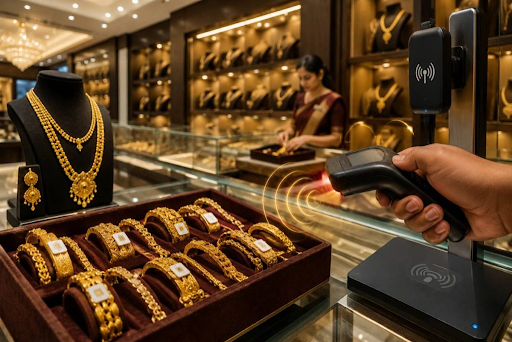
How Dubai Jewellery & Watches Improved Inventory Accuracy to 99% Using RFID
In the moving jewelry and watches industry keeping track of inventory is very important.This will help ensure protection of goods, service provision, and operation management.Traditionally managing inventory has been done by counting items using spreadsheets and scanning barcodes. People used to keep track of stock by counting each item. Checking things physically again and again. These methods can take a lot of time. Might lead to mistakes while counting, things getting lost or records not being complete.
Dubai Jewellery & Watches faced the challenge of managing valuable inventory while maintaining visibility across daily operations. To address these challenges the company adopted an RFID-based approach that transformed inventory tracking and improved inventory accuracy to 99%. This case demonstrates how RFID Jewelry Management can help jewellery businesses create more reliable and more transparent inventory processes.
The Inventory Challenge
Inventory management is critical for both jewelry and watches. There are changes in jewelry and watches’ inventories due to sales, transfers, returns, and display. Keeping the records in sync with those changes can become hard. For Dubai Jewellery & Watches the usual inventory methods caused operational problems. Manual stock checks made employees walk around to physically check each product and match it to the records. This task could take a long time , especially when a full stock audit is done. Finding an item also relied a lot on accurate hand‑written records and the knowledge of the staff.
RFID-Based Jewellery Inventory Management
The company brought in RFID to make inventory identification faster and easier. Every piece of jewelry or watch had an RFID tag that had a number. RFID scanners could then pick up tagged items at once without needing to see them directly.
This made the inventory process more linked together. By looking at each item one by one, with old ways workers could use RFID scanners to check groups of items fast. The information gathered was then linked to the inventory system, which helped update and check stock records better and quicker.
How the RFID Process Worked
First RFID tags were given to jewelry and watches. Connected with the correct product details in the inventory database. The tag gave each item a digital identity. Next RFID readers picked up the tags that were in their area. Since RFID can find items at once during a scan workers could finish checking inventory faster than when using barcode scanning one by one.
The system then looked at the information that was scanned and matched it with the records in the inventory. Items that were missing listed more than once or not expected could be found during the check. Workers could look into these differences. Change the records based on the real stock that was there. Finally the inventory data could be used to make reports and help make business choices. It provided managers an idea of the stock availability and also made the process of auditing easy for teams.
Improving Inventory Accuracy to 99%
The significant achievement resulting from the implementation of RFID is improving the inventory accuracy to 99 percent. This level of accuracy mattered a lot because accurate inventory data supports every part of jewellery retail operations. When the data is right everything runs smoother.
With product identification employees made fewer mistakes during manual counts. They could also spot extra items faster. Stock checks became more organized and consistent. Digital records matched the stock closely giving a clearer picture of what was actually in the store. Stock checks gave a view of the stock.
The improvement in accuracy also made audits easier. Depending on handwritten notes or spreadsheets teams could use the data, from RFID systems.
Faster Stock Audits and Better Visibility
Moreover, RFID technology speeds up and simplifies the stock audit process. Usually, traditional systems involve manual handling of each item individually, followed by writing information down and then performing another verification check to spot any discrepancies. The use of RFID allows scanning of a number of tagged items all at once, which decreases the amount of work.
This feature plays an important role in the case of jewellery companies. In addition to saving employee time that can now be used for customer support or some other activity, the faster update of inventory information allows managers to make decisions about available goods, orders, moving, or positioning of items in a shorter period of time.
Thus, the additional insight provided by RFID Jewelry Management into the whereabouts of goods allows checking the validity of the information stored in the system and avoids mistakes.
Reducing Manual Effort and Operational Errors
A big benefit of RFID is cutting down on repeated work. When details about stock are gathered on their own workers don’t have to depend on notes written by hand or checking each item individually. For jewelry and timepieces cutting down on extra touching and making sure the steps are the same each time can help create better control over what is in stock.
Importance of RFID Jewelry Management
The importance of RFID jewelry management is growing because of jewelry retailers that need more precise methods of managing their inventory. This system gives each item a digital identity.
The implemented RFID system could provide assistance in stock counting, product identification, inventory reconciliation, movement tracing, and report generation. It also provides a platform for integration of the inventory data into other enterprise systems and retail management systems.
The Acube Advantage
Acube Infotech offers RFID solutions that help businesses get a view of their inventory. These solutions improve accuracy. Make operations run more smoothly. For jewellery and watch retailers the RFID Jewelry Management solution can be tailored to fit tagging needs, reader setups, inventory software and how the business already works.
The goal is not just to swap out scanning with technology. It’s about building an inventory system where every tagged item can be quickly found and matched up with digital records.
The deployment of RFID in Dubai Jewellery & Watches proved the effectiveness of the system. It contributed to inventory management and ensured 99% accuracy of the inventory. With audits, better visibility of products, less need for manual work and more trustworthy records, jewellery businesses gain stronger control over their stock.
Conclusion
Accurate inventory is very important for jewellery and watch retailing. As the amount of products and the complexity of operations grow it can be hard to keep inventory processes running at the level of accuracy needed.
The Dubai Jewellery and Watches example shows how RFID can solve these problems by linking products with digital inventory information. With RFID Jewelry Management companies can find products quickly, make audits easier, find mistakes and keep better stock records.
Getting 99% inventory accuracy shows how useful RFID is, for places that sell items. For jewellery businesses that want to update their inventory systems RFID provides a way to improve accuracy, see what is happening and work efficiently.